Bronze To Unreal Speedrun In Fortnite Reload
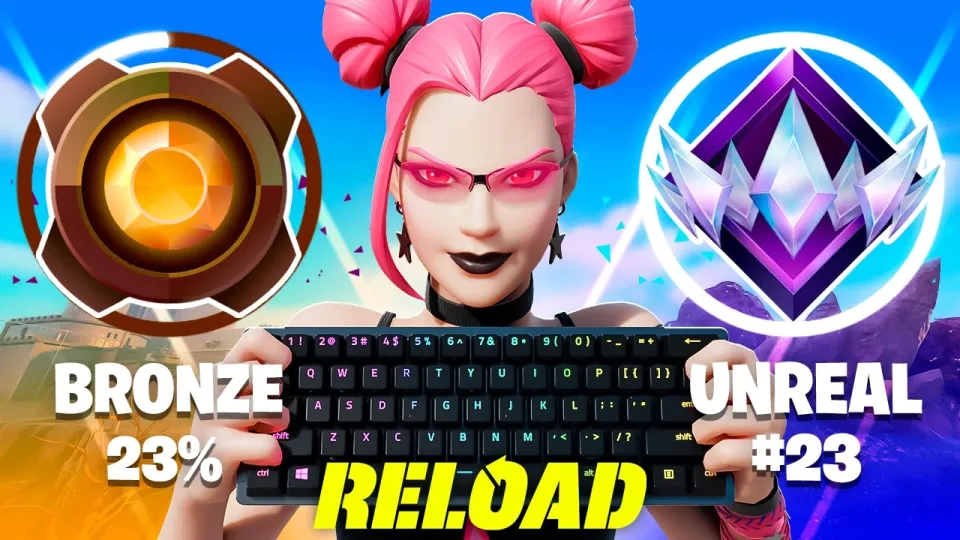
Video: BRONZE To UNREAL Ranked Speedrun In Fortnite Reload!
Need articles like this for your video? They help promote it on YouTube and Google — order them in the Telegram bot @sat_sit_bot. Articles with your video embedded are written and posted by the bot itself — on popular topical sites (no ads). Try it free: 50 articles on us.
Key takeaways
- Fortnite Reload is a faster, respawn-based mode where ranked climbs move quicker than in standard Battle Royale.
- The climb spans eight tiers: Bronze, Silver, Gold, Platinum, Diamond, Elite, Champion and Unreal.
- HaloBT runs the challenge solo, moving from Bronze to Unreal in Fortnite Reload.
- HaloBT built a mechanics training map, Elite Aim Edit Piece, with map code 6317-4546-8691.
- Gold is the usual choke point: players report it feeling like a tournament final.
A Bronze to Unreal speedrun in Fortnite Reload is a ranked climb that starts at the bottom tier of Fortnite's competitive ladder and pushes through every division up to Unreal, the game's top rank, using Reload's faster respawn-based matches instead of standard Battle Royale. HaloBT takes on exactly that challenge in the video "BRONZE To UNREAL Ranked Speedrun In Fortnite Reload!", running the whole grind solo. Players who want to practice the mechanical side of the climb can grab HaloBT's own training map through his Fortnite creator page at fortnite.com/@MoreHaloBT, which hosts his competitive practice builds and updates.
What the Fortnite Reload ranked ladder actually looks like
Fortnite's ranked system is a tier ladder, and Reload plugs into it with its own ranked queue rather than a separate progression track. The order runs Bronze, Silver, Gold, Platinum, Diamond, Elite, Champion and finally Unreal, with each tier below Elite split into three sub-divisions. Bronze to Unreal therefore means clearing roughly twenty individual rank steps before the top badge appears.
Reload changes the pace of that climb in two ways. First, matches are shorter and lobbies are smaller, so a single bad drop costs less time than it would in a full Battle Royale game. Second, respawns keep players in the fight, which means more engagements per hour and more chances to earn placement and elimination points. That combination is why a Bronze to Unreal push is realistic in Reload in a way it rarely is in standard ranked.
How the speedrun is structured from Bronze upward
The early tiers are about volume, not perfection. In Bronze, Silver and even Gold, points come quickly if a player survives to the mid-game and takes fights they can win, because the ranked system rewards both placement and eliminations. A speedrunner's goal in this stretch is to avoid zero-point games: one early death with no kills is the only real setback at this level.
From Platinum onward the lobbies tighten. Players there tend to hold height, play for zone information and third-party fights, so raw aggression stops paying on its own. The practical structure of the climb looks like this:
- Bronze to Gold: push every fight that is roughly even, bank eliminations, and never land somewhere without a plan for the first rotation.
- Platinum to Diamond: prioritize consistent top-five finishes and take only fights where you have a health or positioning advantage.
- Elite to Champion: treat every game as a placement game first; points per match matter less than avoiding a -0 run of early deaths.
- Champion to Unreal: grind volume, because the gap between Champion and Unreal is measured in accumulated points rather than a single promotion match.
Why Gold is the real wall in a ranked speedrun
Gold is the tier most players name as the turning point, and the reason is structural rather than psychological. Below Gold, the ranked system is generous enough that a decent player climbs on eliminations alone; at Gold, the point thresholds rise while the lobby skill floor does too, so the same aggressive style stops producing net gains. Viewers of HaloBT's run described Gold as feeling like a tournament final, which matches how the tier plays: crowded mid-games, contested rotations and far fewer free kills.
The fix is not to play slower but to play more selectively. Winning a 50/50 in Gold is worth less than surviving into a position where the next fight is a 70/30. Players who stall at Gold usually have mechanics good enough for the tier and decision-making that belongs one or two ranks below it.
Solo queue versus duo fills in Reload
Solo is the cleaner test of individual skill, and it is the format HaloBT uses for this Bronze to Unreal attempt. There is no teammate to cover a bad rotation, no shared loot pool and no reliance on a partner's callouts, so every point earned reflects the player's own decisions. The trade-off is that solo Reload punishes mistakes instantly and offers no revive safety net beyond the mode's own respawn rules.
Duo fills sit at the other end. Random partners add variance: a strong fill can carry a mid-game, while a passive one forces you into fights you would otherwise skip. For a speedrun, variance is the enemy, which is why most serious climbs are attempted solo or with a fixed partner rather than through fills. If you do use fills, treat the first two minutes as an audition: if your partner rotates and shares information, play around them; if not, play your own game and treat them as a distraction for enemies.
Practice tools that shorten the climb
Mechanics are the part of ranked that can be trained outside of matches, and HaloBT has packaged that training into a dedicated map. His Elite Aim Edit Piece map, listed under map code 6317-4546-8691 or by searching "halobt" in Fortnite, is built for aim, edit and piece-control drills. Players who have used it report measurable improvement in building confidence, including controller players on PS5 who found building far less intimidating after running the drills.
A practical routine before a ranked session looks like this:
- 10 minutes of aim drills against moving targets to warm up tracking and flick timing.
- 10 minutes of edit courses to keep edit speed and piece control sharp.
- 2 to 3 warm-up Reload matches where you deliberately take fights, not just survive.
- Then start the ranked climb, and stop the session after two consecutive low-point games rather than tilting through a losing streak.
Common questions from players chasing Unreal
The most frequent concern among players working toward Unreal is a plateau: improvement that was fast after switching input or settings suddenly flattens. The usual cause is that mechanics have outrun game sense. Fixing it means reviewing deaths and asking whether the fight was necessary, not whether the aim was good. A second recurring theme is input choice; controller and keyboard players both climb to Unreal, but controller players often lean on aim assist in close range while keyboard players gain an edge in edit speed. Neither input blocks the climb.
A third theme is rank anxiety. Players report sitting at a rank for weeks because they stop queuing after a bad game. In Reload, where matches are short, the cost of a bad game is small, so the correct response to a losing streak is a short break and then more volume, not fewer games.
Useful links
- HaloBT's Fortnite creator page with practice maps: https://www.fortnite.com/@MoreHaloBT
- Community Discord: https://discord.com/invite/halobt
- Twitch streams: https://www.twitch.tv/halobt
- Twitter: https://twitter.com/halobombtrooper
- Instagram: https://www.instagram.com/therealhalobt
Final thoughts on the Bronze to Unreal grind
A Bronze to Unreal run in Fortnite Reload is less about raw talent than about volume, selective fighting and knowing which tiers demand patience. The ladder rewards consistency: the player who avoids zero-point games will always out-climb the player who wins spectacular fights and dies early. HaloBT's run shows the shape of that grind from the bottom tier to the top badge, and the channel is worth following for anyone who wants to see how ranked decisions play out at speed. If you want to train the mechanical half of the climb yourself, start with the practice maps on HaloBT's Fortnite page before your next ranked session.
Source: BRONZE To UNREAL Ranked Speedrun In Fortnite Reload! · Markdown version
Questions & answers
How long does a Bronze to Unreal speedrun take in Fortnite Reload?
It depends on win rate and points per match, but Reload's short matches and respawns make the climb far faster than standard Battle Royale. Most of the time is spent in Gold through Diamond, where point thresholds rise and lobbies get tougher. Volume matters more than any single result.
Can you reach Unreal in Fortnite Reload playing solo?
Yes. Solo is the cleanest way to climb because every point reflects your own decisions, and HaloBT's run is done solo. The trade-off is that there is no teammate to cover a bad rotation, so positioning mistakes are punished immediately.
Why do players get stuck in Gold during a ranked climb?
Gold is where point thresholds rise while the lobby skill floor also increases, so an aggressive style that worked in Silver stops producing net gains. The fix is selective fighting: take fights where you have a clear advantage instead of every even 50/50.
What is the best way to practice for a Fortnite ranked climb?
Warm up outside of ranked with aim and edit drills, then play a few matches where you deliberately take fights rather than hiding. HaloBT's Elite Aim Edit Piece map, code 6317-4546-8691, is built for exactly that kind of mechanical practice.