How can you cheat in Chess.com and what actually happens when you do
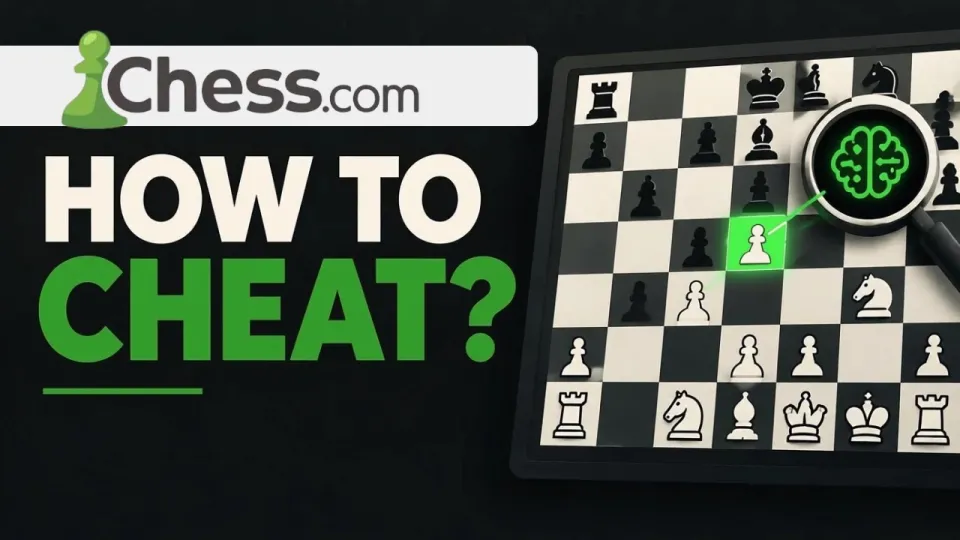
Video: How to cheat in Chess.com (Chess.com cheats)
Key takeaways
- The most advertised method is a browser userscript or extension installed via a manager such as Tampermonkey, distributed through third-party sites like xmods.cc.
- Such tools typically overlay Stockfish engine evaluations on the live board so the player can copy the top move.
- Chess.com's anti-cheat compares your moves with engine recommendations and tracks timing, accuracy and device fingerprints.
- Fair-play closures usually come with a rating reset, a closed account and, for titled players, public statements.
- No client-side tool can hide engine-level accuracy from statistical detection over a sample of games.
The short answer: people cheat on Chess.com by running a chess engine alongside the site, most commonly through a browser extension or userscript that overlays Stockfish's suggested move on the live board, such as the one distributed at the xmods.cc cheat page. It is technically easy to install and just as easy for Chess.com's detection systems to flag, which is why most accounts using it are closed within weeks rather than months.
What a Chess.com cheat extension actually does
A Chess.com cheat extension does not hack the server or change the result of a game; it reads the position from the page and asks a local engine what to play. The typical package is a userscript loaded through a browser extension manager, or a standalone extension that injects a script into the chess.com domain. Once active, it watches the board state, sends the position to an embedded or remote Stockfish build, and paints an arrow or a small panel with the engine's preferred move and an evaluation score.
The user then plays that move manually. Some builds add extras: a move-history panel, an evaluation bar, an opening-book lookup, or a hotkey to hide and show the overlay. None of this touches Chess.com's account data, which is exactly why the method depends entirely on not being noticed rather than on any real protection.
Step-by-step: how the browser method is set up
The setup described for these tools follows the same pattern across most userscript-based cheats. The steps below reflect how the category works in general, not a guarantee that any specific build is safe or functional.
- Install a userscript manager in your browser (Tampermonkey is the one named in most Chess.com cheat tutorials).
- Open the distribution page, in this case the xmods.cc item page, and add the script to the manager.
- Confirm the script is enabled for the chess.com domain and reload the site.
- Start a game and look for the overlay: an engine arrow, an evaluation number, or a floating panel.
- Play the suggested move manually, keeping your timing plausible.
That last point is where most users fail. A script that shows you the best move is trivial; a script that makes you play like a 2400 while your account history says 900 is not, and the mismatch is the signal the anti-cheat looks for.
How Chess.com's anti-cheat catches engine users
Chess.com's fair-play team does not rely on a single test; it builds a statistical profile of each account and compares it with engine output. The core signals are move-matching (how often your move equals the engine's top choice, especially in sharp positions where the top choice is unique), accuracy relative to your rating history, and time management.
Human players show a characteristic pattern: they think longer in complex positions, blunder occasionally, and their accuracy drops as the game lengthens. Engine-assisted players show the opposite — flat thinking times, near-constant accuracy, and a suspiciously high match rate in positions where the best move is non-obvious. Sudden rating jumps, especially across many games in a short window, are another flag. The system also looks at device and connection data, so switching accounts on the same hardware does not reset the picture.
Typical questions from people trying these tools
Most confusion around Chess.com cheats is practical rather than technical. Users frequently cannot find the overlay after installing the script, which usually means the manager is disabled for the domain, the script version is out of date after a site update, or an ad blocker is interfering with the injected panel. Others ask how to use the tool inside a live game: the answer is that you play the move yourself, because the script only displays information.
Another common doubt is whether the tool works in all formats. It generally works in any game rendered in the browser, including bullet, blitz, rapid and daily, but faster controls make copying moves harder and produce timing patterns that look unnatural. Reports of the tool "working fine" tend to come from short sessions; the detection window is measured in games, not minutes, so a few wins prove nothing about long-term safety.
What happens if you get caught
Getting caught on Chess.com means more than losing a game. Accounts flagged for engine use are closed, ratings are removed, and the closure is recorded against the account rather than quietly reversed. For titled players, Chess.com publishes fair-play statements, and repeated violations can lead to bans from prize events and cooperation with other platforms.
The practical cost is the account itself: years of game history, tournament entries and any paid membership disappear with it. Because detection is statistical, it also catches players who use an engine intermittently, not just every game — a handful of assisted games inside a hundred clean ones is still visible in the match-rate data.
Alternatives that raise your rating without risking the account
If the goal is a higher Chess.com rating, the legitimate route is more effective per hour than any overlay. Puzzle Rush and the daily puzzle build pattern recognition; the analysis board after each game shows exactly where the evaluation swung; opening trainers keep your first ten moves sharp so you spend clock time on the middlegame. Playing longer time controls — 15+10 rather than 3+0 — gives you the repetitions that actually transfer to tournament play.
Coaching and review matter more than volume. Reviewing two lost games carefully beats playing twenty blitz games on autopilot, and Chess.com's own game report highlights the specific move types you keep missing. None of this requires a third-party script, and none of it can be retroactively deleted by a fair-play decision.
Bottom line on Chess.com cheats
Cheating on Chess.com is technically simple — a userscript manager plus an engine overlay, distributed through sites like xmods.cc — and strategically pointless, because the anti-cheat measures exactly the thing the cheat produces: engine-level accuracy that does not match your history. The video breakdown by the channel Matyc walks through the extension route and shows how quickly it can be installed; what it cannot show is an account surviving that pattern over a real sample of games. Treat the method as a demonstration of how detection works, not as a plan for climbing the leaderboard.
Frequently asked questions
See the FAQ section below for the practical details on installation, detection and account consequences.
Source: How to cheat in Chess.com (Chess.com cheats) · Markdown version
Questions & answers
Does a Chess.com cheat extension actually work in live games?
Yes, in the sense that it reads the position and displays an engine move while you play in the browser. It does not play the move for you, so you still have to move the piece yourself. Whether the account survives is a separate question, and the answer is usually no over a longer sample of games.
Why can't I find the overlay after installing the script?
The most common causes are a disabled userscript manager, a script that broke after a Chess.com front-end update, or an ad blocker stripping the injected panel. Check that the script is enabled specifically for the chess.com domain and reload the page before starting a game.
How does Chess.com detect engine use?
It compares your moves with engine recommendations, tracks accuracy against your rating history, and analyses thinking times and device data. Flat accuracy, near-constant move-matching in sharp positions and sudden rating jumps are the classic signals. The evaluation is statistical and spans many games, not one.
What is the penalty for cheating on Chess.com?
Flagged accounts are closed and their ratings removed, and the closure stays on record. Titled players can face public fair-play statements and exclusion from prize events. Paid membership and game history are lost with the account.